COMMITTED TO Environmental Best Practices

Circular Economy

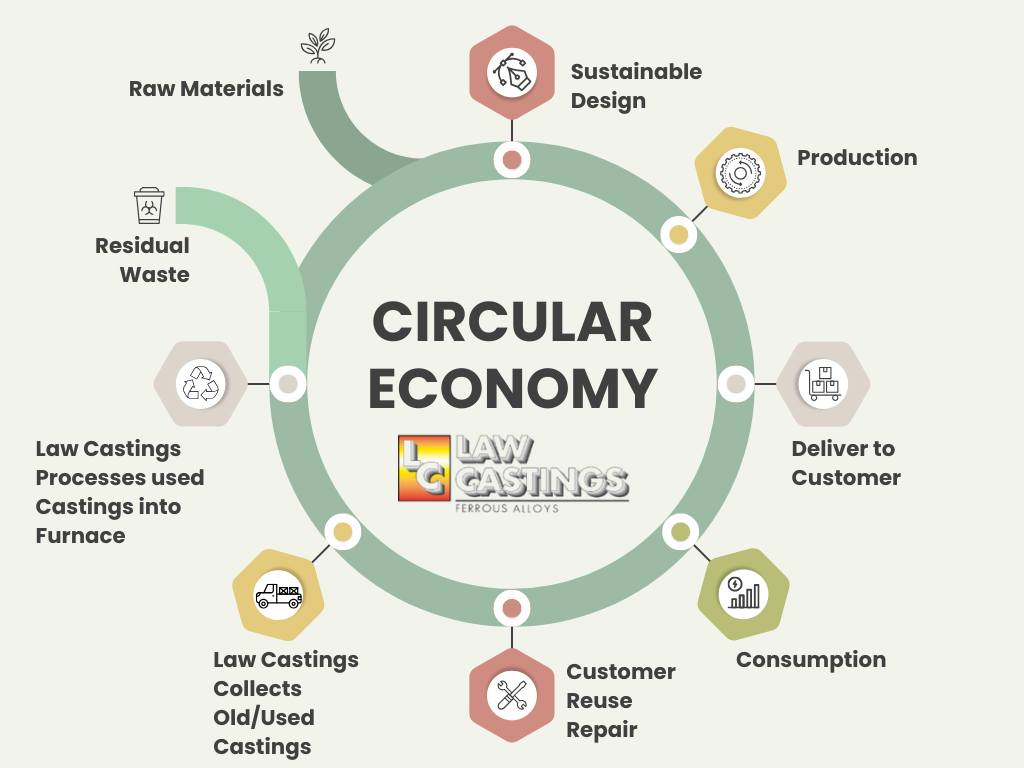
At Law Castings, we adopt a Circular Economy with our major customers by purchasing their worn-out castings and recycling them into new castings.

A circular economy is a model of production and consumption that aims to minimise waste and maximate the use and reuse of resources

It’s a shift away from the traditional “take-make-dispose” linear economy towards a more sustainable, closed-loop system where materials are kept in use for as long as possible through strategies like reuse, repair, refurbishment, and recycling. Key principles:

Examples in practice

Product Design

Designing products for durability, repairability, and recyclability.

Waste Management

Implementing effective recycling and composting programs.

Sharing Economy

Platforms for sharing goods and services, reducing the need for individual ownership.

Remanufacturing

Restoring used products to their original condition.
Contrast with Linear Economy

A circular economy aims to eliminate waste and pollution by keeping materials in use for as long as possible, constantly circulating and regenerating resources.

A linear economy involves extracting raw materials, manufacturing products, using them, and then discarding them as waste.

The Circular Economy Model: less raw material, less waste, fewer emissions

Benefits of a Circular Economy

Environmental Protection

Reduced waste, pollution, and greenhouse gas emissions.

Economic Growth

Opportunities for innovation, job creation, and resource efficiency.

Social Progress

Improved resource security and access to goods and services.

Request a Free Quote Today